












Uber and British autonomous driving company Wayve have launched supervised self-driving rides in London, giving the public its first chance to book an autonomous ride in the UK.
The service began on 3 September. Customers booking UberX, Uber Electric or Uber Comfort in London can now be matched with a Wayve vehicle at no extra cost.
The initial rollout is small. Uber says it is starting with a limited number of vehicles and will expand the service gradually as demand, technology and regulation develop. More than 140,000 London Uber customers had already opted in to increase their chances of being matched with a Wayve vehicle.
The launch puts London at the centre of the UK’s growing autonomous vehicle market.
How the self-driving Uber service works
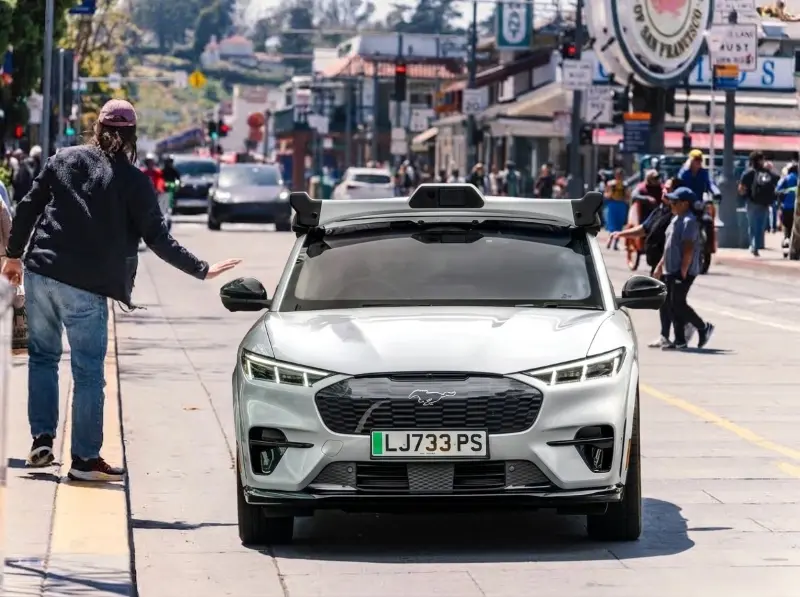
The vehicles are all-electric Ford Mustang Mach-E cars fitted with Wayve’s AI Driver software and surround sensors.
Customers who are matched with a Wayve vehicle can see the trip through an interactive screen inside the car. The system also shows the planned route and supports 64 languages.
The ride works through the normal Uber app. Customers can accept the Wayve vehicle or change to a conventional Uber before the car arrives.
The vehicles can operate across London, although airports are excluded from the launch area.
Despite being described as self-driving, the vehicles are not yet operating without a person behind the wheel.
Each journey has a trained, Transport for London-licensed private hire driver in the vehicle. The driver supervises the trip and can take control when required.
That makes the current service different from fully driverless robotaxi operations already running in some other markets.
Why the 15-vehicle figure matters
The launch is deliberately starting on a small scale.
TfL has licensed a limited group of modified Ford Mustang Mach-E vehicles for the supervised service, while Uber and Wayve have said the fleet will grow gradually rather than expanding immediately to large numbers.
That means most Londoners requesting an Uber will still receive a conventional vehicle.
The more important figure at this stage may be the 140,000 people who have opted in. It gives Uber and Wayve an early indication of public interest before the service expands.
Wayve’s technology
Wayve has been developing its autonomous driving technology in London since 2018.
Its AI Driver is designed to learn from driving data and operate without relying on traditional high-definition maps. Wayve says its system is designed to adapt to different roads and environments, which is central to the company’s plans to expand the technology beyond London.
London provides a demanding environment for that technology.
The city has busy roads, narrow streets, cyclists, pedestrians, buses and complex junctions. Wayve says it has trained and tested its technology on London’s roads for years.
The company is now moving from testing with safety drivers to allowing members of the public to experience the technology through Uber.
London becomes a new robotaxi battleground
Uber and Wayve are not the only companies preparing autonomous vehicle services in London.
Waymo and Baidu are also working on autonomous vehicle projects in the capital. The London Assembly has been examining the growth of autonomous passenger vehicles as several operators prepare for commercial services.
That makes the Uber-Wayve launch an important step in London’s development as a market for autonomous transport.
For Uber, the partnership also forms part of a wider global autonomous vehicle strategy. The company says it is working with more than 30 autonomous vehicle partners across mobility, delivery and freight. It expects to facilitate autonomous trips in as many as 15 cities by the end of 2026.
What happens when the driver is removed?
The next stage will be more difficult.
The UK has already moved towards a regulatory framework for self-driving vehicles without a safety driver. Government guidance published in March 2026 sets out a pilot scheme that allows automated vehicle technology to operate without a safety driver on roads in Great Britain.
The government has also published requirements covering vehicle approval, the automated driving system and passenger services.
So the current Uber-Wayve launch is not the final stage of London’s autonomous taxi plans. It is a supervised service operating while the technology and regulatory system continue to develop.
Wayve has said it plans to move towards fully autonomous services, but the company has not given a firm date for removing the safety driver from its London rides.
What it means for Uber drivers
The expansion of autonomous taxis will also bring questions about the future of driving work.
Uber has said it expects autonomous vehicles and human drivers to operate alongside each other as the market develops. The company also argues that autonomous technology could eventually improve safety and reduce costs.
For now, however, the London service still depends on a trained driver sitting inside every vehicle.
That means the immediate effect on London’s existing private hire workforce is likely to be limited by the size and supervised nature of the launch.
The longer-term impact will depend on how quickly autonomous vehicles become commercially viable and how regulators allow them to expand.
A first step rather than a full switch
London’s first public autonomous Uber rides are an important milestone, but the service is still at an early stage.
Passengers can now request a Wayve vehicle through Uber, but the cars remain supervised and the initial fleet is small.
The next test will be whether the technology can operate safely at a much larger scale and eventually move beyond supervised driving.
For now, London has moved from autonomous vehicle trials to public rides. The wider shift to fully driverless taxis will take longer.