












Choosing a business bank account is about more than the monthly fee. Cash deposits, cheque charges and international transfers can all affect what a business pays.
HSBC UK offers several business banking options, from accounts for small businesses to services for larger companies with international needs. Some accounts have no monthly fee, while others include relationship management and additional support.
There are also important pricing changes coming on 14 December 2026. These affect cash services and some international banking costs.
This guide explains the main HSBC business accounts, who can apply, what they cost and what businesses should check before opening one.
HSBC business accounts at a glance
HSBC has different accounts for different types of organisations. The right choice depends on the size of the business, its banking needs and the level of support it requires.
| HSBC account | Main features | Monthly account fee |
|---|---|---|
| Small Business Banking Account | Everyday banking for small businesses and start-ups | Free |
| Business Banking Account | Banking support and access to relationship management | £10 after the introductory period |
| Charitable Bank Account | Banking for eligible charities and not-for-profit organisations | Free |
| Corporate Banking | Services for larger businesses with more complex needs | Individually agreed |
| International Business Account | Banking for businesses with international requirements | Depends on the linked business banking relationship |
| Currency Client Account | Holds client money in selected foreign currencies | Check HSBC’s current charges |
The Small Business Banking Account is aimed at businesses that need everyday banking. The Business Banking Account is designed for organisations that need a wider level of support, including businesses seeking larger borrowing facilities.
HSBC says its Business Banking customers typically have more complex requirements and may need funding above £100,000. Lending is subject to eligibility, affordability and credit checks.
The Charitable Bank Account is not automatically available to every not-for-profit organisation. Applicants must meet HSBC’s eligibility requirements.
Larger companies may need Corporate Banking services. HSBC generally directs businesses with more complex financing and international requirements towards this service.
Who can open an HSBC business account?
HSBC’s Small Business Banking Account is available to eligible start-ups, small businesses and companies looking to switch banks.
Applicants must meet the bank’s eligibility checks. HSBC also requires applicants to be UK tax residents for this account.
The information requested during an application can include:
- The full business name and registered or trading address.
- Contact details and email address.
- Companies House registration number, where applicable.
- VAT registration number, if required.
- Estimated annual business turnover.
- Personal details of the applicant, partners or company directors.
HSBC may request further information or documents during its checks. The exact requirements depend on the business structure and the people applying.
For a limited company, it is sensible to have the Companies House details ready. Sole traders should prepare their business and personal information before starting the application.
How to open an HSBC business account
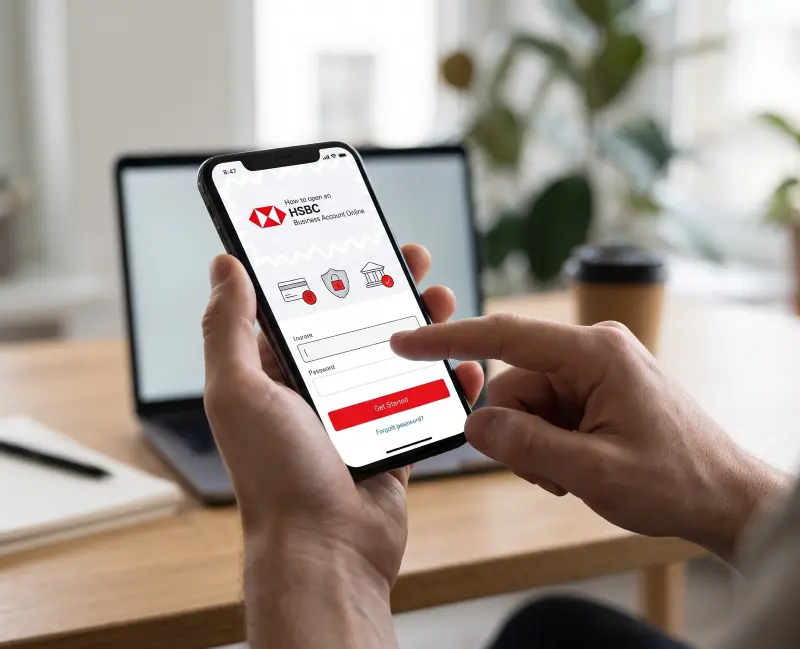
Eligible customers can start an application online through HSBC’s business banking website.
The process generally involves three stages.
1. Check the eligibility requirements
Review the account conditions before applying. Make sure the business structure, residency and banking requirements match the account.
2. Complete the application
Provide the business details and personal information requested by HSBC. The bank may ask for identity checks or additional documents.
3. Wait for HSBC’s decision
HSBC says 65% of Small Business Banking accounts were opened within 24 hours, based on data from March to May 2026. This is not a guaranteed opening time. Applications can take longer if the bank needs more information, and not every application is approved.
Applicants who need help can contact HSBC’s business banking team or use its available support channels.
HSBC business banking fees
The monthly account fee is only one part of the cost. Businesses should also consider cash deposits, withdrawals, cheques and payment charges.
The following figures are based on HSBC’s UK Business Price Lists. The standard charges below exclude any separately agreed pricing or charges that may apply to particular services.
Monthly account fees
| Account | Monthly fee |
|---|---|
| Small Business Banking Account | £0 |
| Business Banking Account | £10 after the introductory period |
| Charitable Bank Account | £0 |
| Corporate Banking | Individually agreed |
The Business Banking Account includes a 12-month introductory offer for eligible start-ups and businesses switching to HSBC. The offer applies to the primary account. After the introductory period, the standard £10 monthly fee applies.
The Small Business Banking Account has no monthly account fee. However, this does not mean every transaction is free. Cash services, cheques and some other activities can still carry charges.
Cash deposits and withdrawals
Cash charges matter most to businesses that regularly handle physical money. This can include shops, restaurants, cafés and other businesses that take cash payments.
For Small Business Banking customers, the current and upcoming charges include:
| Transaction | Until 13 December 2026 | From 14 December 2026 |
|---|---|---|
| Branch cash deposit or withdrawal | 1.5% plus £1.50 per credit or withdrawal | 2% |
| Post Office cash deposit or withdrawal | 1.5% plus £1.50 per credit or withdrawal | 1.5% |
| Self-service cash deposit | 1.5% | 1.5% |
| UK cash machine withdrawal | 25p plus 0.6% of the amount | Free |
The £1.50 counter charge is being removed from branch and Post Office cash transactions from 14 December. However, the percentage charge for branch cash transactions will rise from 1.5% to 2%.
For example, a business depositing £4,000 in cash at a branch currently pays £61.50 under the standard charge: £60 in percentage fees and £1.50 per credit.
From 14 December, the same deposit will cost £80 at the new 2% rate. That is an increase of £18.50.
The Post Office rate will remain at 1.5%, although the separate £1.50 counter charge will be removed. Businesses that deposit cash regularly should compare the available options before choosing where to pay it in.
Cheque charges
Cheque costs can also add up for businesses that still receive payments this way.
Under the standard Small Business Banking charges:
- Branch or Post Office cheque credits cost £1.50 per credit, plus 50p per cheque.
- Mobile cheque deposits cost 50p per cheque.
- Eligible customers can deposit cheques through the HSBC UK Business Banking app.
HSBC’s mobile cheque deposit service has limits. The bank says customers can deposit cheques up to a combined daily value of £5,000, with no individual cheque above £2,000.
Businesses that receive several cheques should check whether mobile deposits are suitable for their needs.
Business payments and CHAPS fees
Many standard electronic payments are free when made through HSBC Business Internet Banking. This includes everyday domestic payments such as eligible transfers, standing orders and direct debits.
CHAPS payments carry a separate fee. The new Business Price List, effective 14 December 2026, sets out these charges:
| CHAPS payment method | Fee |
|---|---|
| Online | £17 |
| By phone or branch to HSBC UK | £20 |
| By phone or branch to another bank | £30 |
| By post | £40 |
CHAPS is generally used when a business needs to send a high-value payment on the same working day, subject to the bank’s cut-off times and payment checks.
For regular supplier payments, businesses should check whether a standard electronic transfer is sufficient before paying for CHAPS.
HSBC international payment fees
International payment costs depend on the currency, destination and method used to send the money.
HSBC’s standard charges for business customers include the following:
| International payment | Standard fee |
|---|---|
| Outgoing payment through Business Internet Banking | £17 |
| Outgoing payment by phone or branch to another HSBC Group bank | £20 |
| Outgoing payment by phone or branch to another bank | £30 |
| Foreign currency payment within the UK by phone or branch | £30 |
| Outgoing payment by post | £40 |
| Outgoing SEPA payment | 24p |
| Incoming SEPA payment | 20p |
| Incoming payment in another currency below £100 | Free |
| Incoming payment in another currency of £100 or more | £6 |
SEPA payments are used for eligible euro transfers within the Single Euro Payments Area. They can be cheaper than standard international transfers, but businesses should check that the payment and destination qualify.
Other charges may apply if a payment is returned, rejected, cancelled or recalled. Intermediary and recipient banks may also deduct fees before the money reaches the beneficiary.
The payment charge is not the only cost to consider. Currency conversion can affect the final amount received. HSBC converts foreign currency at its quoted exchange rate, so businesses should check the rate and the amount the recipient will receive before confirming a transfer.
HSBC Global Wallet
HSBC Global Wallet is designed for businesses that make and receive payments in different currencies.
The service allows eligible businesses to hold and manage supported foreign currencies. Its standard charges include:
| Global Wallet service | Fee |
|---|---|
| Receive like a local | £5 |
| Pay like a local | £5 |
| International SWIFT payment | £17 |
The available currencies and payment options depend on the service terms. Businesses should check the exchange rate, transfer fee and any receiving-bank charges before sending money.
For companies that regularly pay overseas suppliers or receive money from international customers, these costs can make a noticeable difference over time.
Foreign currency card charges
Businesses using an HSBC business debit card abroad should also check the foreign currency charges.
Under HSBC’s published Business Price List, non-sterling debit card payments carry a 2.75% foreign currency transaction fee.
Cash withdrawals in a foreign currency carry a 2.75% fee, plus a separate cash withdrawal charge of 1.5%, subject to a minimum of £1.75.
These charges are separate from any fee applied by the ATM operator. A business owner travelling overseas should check the total cost before withdrawing cash or choosing a currency conversion option.
Online banking, mobile app and customer support
HSBC business customers can manage their accounts through Business Internet Banking and the HSBC UK Business Banking app.
Available features include:
- Checking balances and recent transactions.
- Making eligible domestic and international payments.
- Managing standing orders and direct debits.
- Viewing connected eligible accounts.
- Depositing eligible cheques through the mobile app.
- Using telephone banking and secure messaging.
Customers can also access cash services through HSBC branches and a network of more than 11,500 Post Office locations.
HSBC lists business customer support hours as Monday to Friday, 8am to 8pm, and Saturday, 8am to 2pm. Opening hours can change, so customers should check the bank’s contact page before calling.
Digital banking is useful for everyday account management, but businesses that regularly deposit cash or need face-to-face support should consider branch and Post Office access when choosing an account.
Is HSBC business banking protected by the FSCS?
Eligible deposits held with HSBC UK Bank plc are protected by the Financial Services Compensation Scheme.
The deposit protection limit increased to £120,000 per eligible person, per authorised banking firm on 1 December 2025.
This is not a separate £120,000 allowance for every HSBC-branded account. HSBC says the limit applies across deposits held with HSBC UK, HSBC Private Banking, first direct, M&S Bank and M&S Savings and Investments because they share the same banking licence.
Businesses should check how the FSCS rules apply to their organisation and account. The protection depends on eligibility and the legal structure of the depositor. It is not a guarantee that every business deposit is covered in every circumstance.
Is HSBC the right business bank for your company?
HSBC may suit businesses that want a large established bank, access to UK cash services and support with international payments.
The Small Business Banking Account may be worth considering for start-ups and smaller companies that mainly need everyday banking and digital payments. Its lack of a monthly account fee is useful, but cash and cheque charges still matter.
The Business Banking Account may suit companies that want a relationship manager or expect to need more extensive banking support. Businesses should factor in the £10 monthly fee after the introductory period.
Companies that regularly trade overseas should compare HSBC’s international transfer charges and exchange rates with their expected payment volumes. A low transfer fee does not always mean the overall currency conversion cost is low.
Businesses that handle large amounts of cash should pay particular attention to the December 2026 changes. The new 2% branch cash charge could make regular deposits more expensive.
Before applying, compare the full price list with the way your business actually operates. The cheapest account on paper may not be the cheapest once transaction charges are included.
Frequently asked questions
Does HSBC charge a monthly fee for a business account?
The Small Business Banking Account has no monthly account fee. The Business Banking Account costs £10 per month after the 12-month introductory offer for eligible start-ups and switchers. Other account types have their own pricing.
Can a new business open an HSBC business account?
Eligible start-ups can apply for an HSBC Small Business Banking Account. Applicants must meet the bank’s eligibility requirements and provide the requested business and personal information.
How long does HSBC take to open a business account?
HSBC reported that 65% of Small Business Banking accounts were opened within 24 hours, based on March to May 2026 data. This is not a guarantee. Some applications take longer if further checks or documents are needed.
Are HSBC business bank transfers free?
Many standard domestic digital payments are free through Business Internet Banking. CHAPS and international payments have separate charges, and other fees may apply depending on the payment type.
What are HSBC’s international payment fees?
Standard outgoing international payments made through Business Internet Banking cost £17 under the published price list. SEPA payments have different charges, while Global Wallet payments have their own fees. Exchange-rate costs and intermediary bank charges may also apply.
Is money in an HSBC business account protected by the FSCS?
Eligible deposits with HSBC UK Bank plc are protected up to £120,000 per eligible person under the FSCS rules. The limit is shared across brands operating under the same banking licence, and eligibility conditions apply.
Information checked on 9 November 2026. HSBC’s fees and account terms can change. The upcoming charges in this guide are due to take effect on 14 December 2026. Check HSBC’s latest Business Price List and account terms before applying or making a payment.