













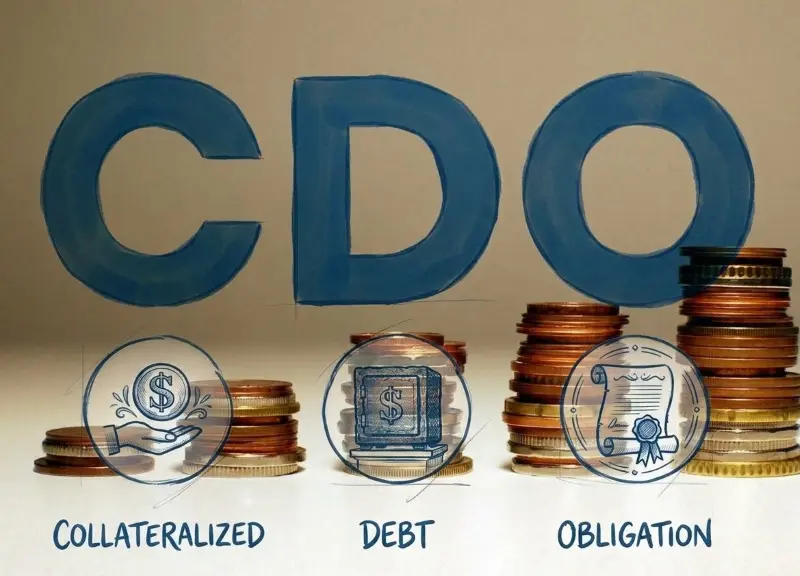
A collateralised debt obligation, or CDO, is a structured financial product that pools debt or debt-related assets and turns the expected payments into securities for investors.
The assets may include corporate loans, bonds, mortgages or other credit-related investments. The securities are divided into layers called tranches. Each tranche has a different position in the payment structure and carries a different level of risk.
CDOs became closely associated with the 2008 financial crisis after mortgage-related CDOs suffered heavy losses. However, the wider idea of pooling debt and dividing cash flows into different risk levels remains part of modern financial markets.
How Does a CDO Work?
A financial institution or special-purpose company first gathers a portfolio of debt assets. The portfolio may contain hundreds or thousands of loans or securities.
The assets generate payments, such as interest and principal repayments. Those cash flows are then distributed to investors according to the rules of the CDO.
The structure normally divides investors into three main levels:
- Senior tranche: This tranche receives payments first and is protected by the losses absorbed by the lower layers. It usually carries a lower credit risk and offers a lower potential return.
- Mezzanine tranche: This layer receives payments after the senior tranche. It faces greater exposure to losses but may offer a higher return.
- Equity tranche: This is the first layer to absorb losses. It carries the highest risk but may receive the greatest potential return if the underlying assets perform well.
A senior tranche may receive a high credit rating because of the protection provided by the lower tranches. That rating does not mean that every asset in the underlying pool is safe.
A Simple CDO Example
Imagine a CDO backed by a $500 million portfolio of debt assets.
The structure is divided into:
- $400 million senior tranche
- $75 million mezzanine tranche
- $25 million equity tranche
Now assume that losses on the underlying assets reach $40 million.
The equity tranche absorbs the first $25 million and is wiped out. The remaining $15 million is taken from the mezzanine tranche, reducing it from $75 million to $60 million.
The senior tranche is not affected in this example.
If losses rise to $125 million, the entire equity tranche and mezzanine tranche are lost. The remaining $25 million reduces the senior tranche from $400 million to $375 million.
This example shows how subordination works. Lower-ranking investors absorb losses before senior investors. The protection is only effective while losses remain within the limits assumed when the CDO was created.
Why Did CDOs Become Linked to the 2008 Crisis?
CDOs existed before the financial crisis, but many products created during the housing boom were linked to mortgage-related securities.
Some of those securities were backed by US subprime mortgages. These were home loans made to borrowers who generally presented higher credit risks than borrowers with stronger financial profiles.
During the housing boom, mortgage lending and mortgage securitisation expanded rapidly. Loans were packaged into mortgage-backed securities, and some of those securities were later used as assets in CDOs.
The structure created several risks.
Weak lending standards
In parts of the US mortgage market, lending standards deteriorated before the crisis. Some borrowers received loans that became difficult to repay when house prices stopped rising or borrowing costs increased.
Limited information
Investors did not always have a clear view of the quality of the loans behind complex securities. The more layers a product contained, the harder it could be to understand the underlying risks.
Overreliance on credit ratings
Some CDO tranches received high ratings because the structure provided protection against a limited level of losses. However, the models used to estimate risk depended on assumptions about defaults, house prices and the relationship between different loans.
Correlated defaults
The models often depended on the idea that defaults would not all happen at the same time. That assumption became unreliable when falling house prices and rising unemployment affected borrowers across large parts of the US.
As mortgage defaults increased, losses moved through the lower tranches and eventually reached senior securities that had previously been viewed as highly protected.
What Happened During the Financial Crisis?
The CDO market expanded sharply before the 2008 crisis. Data published by the Securities Industry and Financial Markets Association showed that global funded CDO issuance reached $488.6 billion in 2006, compared with $249.3 billion in 2005.
The first major warning signs appeared in 2007.
Two hedge funds managed by Bear Stearns collapsed after suffering heavy losses linked to mortgage-related securities. In March 2008, Bear Stearns was acquired by JPMorgan Chase with support from the US Federal Reserve.
AIG also faced severe pressure after selling large amounts of credit default swap protection linked to mortgage-related securities. As the value of those securities fell, AIG faced large collateral demands and required government assistance.
The crisis exposed weaknesses in mortgage lending, securitisation, risk modelling, credit ratings and financial regulation.
In the United States, the Dodd-Frank Act introduced several reforms. These included new rules concerning securitisation, investor disclosures and the retention of credit risk by certain market participants.
Did CDOs Disappear After 2008?
The market for mortgage-related CDOs contracted heavily after the crisis. However, the broader practice of pooling debt and dividing it into tranches did not disappear.
One important form of the structure is the collateralised loan obligation, or CLO.
A CLO is a type of CDO backed mainly by corporate loans, often including loans made to companies with higher levels of debt. The cash flows from those loans are distributed among different investor tranches.
A CLO is therefore not simply a CDO renamed after 2008. It is a specific form of collateralised debt obligation with a different underlying asset base.
CLOs have become a major part of the corporate credit market. Their risks are different from those associated with the mortgage-related CDOs at the centre of the financial crisis, but they are not risk-free.
Potential risks include:
- Corporate borrowers failing to repay loans
- Higher default rates during an economic downturn
- Falling recovery values after a default
- Concentration in particular industries
- Problems caused by several borrowers facing the same economic pressure
- Losses reaching higher tranches during a severe credit event
Regulators continue to monitor CLOs, leveraged lending and other forms of structured credit.
CDOs and Securitisation: What Is the Difference?
Securitisation is the broader financial process of pooling assets or cash flows and turning them into tradeable securities.
A CDO is one type of securitisation structure. It focuses on debt or debt-related assets and normally divides the resulting cash flows into different tranches.
Other products use similar principles. For example, a mortgage-backed security is backed by mortgage loans, while a CLO is generally backed by corporate loans.
The terms are related, but they are not interchangeable:
- Securitisation: The broader process
- CDO: A structured product based on pooled debt or credit assets
- CLO: A type of CDO backed mainly by corporate loans
- Mortgage-backed security: A security backed by mortgage loans
Why CDOs Still Matter
CDOs show how financial institutions can use securitisation to move credit risk between different investors.
The structure can help provide funding and offer investors exposure to debt markets. However, its safety depends on the quality of the underlying assets, the rules governing the tranches and the assumptions used to measure risk.
The 2008 crisis showed that a complex structure can hide risks rather than remove them. A high-rated tranche may have strong protection under normal conditions but can still suffer losses during a severe and widespread economic shock.
For that reason, investors and regulators continue to examine the assets behind structured products, the assumptions used in risk models and the links between different parts of the financial system.
Frequently Asked Questions
1. What does CDO stand for?
CDO stands for collateralised debt obligation. It is a structured financial product that pools debt or debt-related assets and divides the resulting cash flows into different investment tranches.
2. Are CDOs still used today?
Yes. Mortgage-related CDOs became much less common after the 2008 financial crisis, but the broader structure remains in use. Collateralised loan obligations, or CLOs, are an important example of a modern CDO backed mainly by corporate loans.
3. Are CDOs safe investments?
CDOs are not automatically safe or unsafe. The risk depends on the assets in the pool, the structure of the tranches, the level of protection available and the economic conditions affecting borrowers. Senior tranches may carry less risk than equity tranches, but they can still suffer losses.
4. What is the difference between a CDO and a CLO?
A CDO is a broad category of structured debt product. A CLO is a specific type of CDO that is mainly backed by corporate loans. Mortgage-related CDOs were central to the 2008 crisis, while CLOs generally focus on corporate credit.
5. How did CDOs contribute to the 2008 financial crisis?
Many CDOs were linked to mortgage-related securities, including products backed by subprime mortgages. When US house prices fell and mortgage defaults increased, losses spread through the CDO structure. The crisis also exposed problems with lending standards, risk models, credit ratings and the complexity of securitised products.