





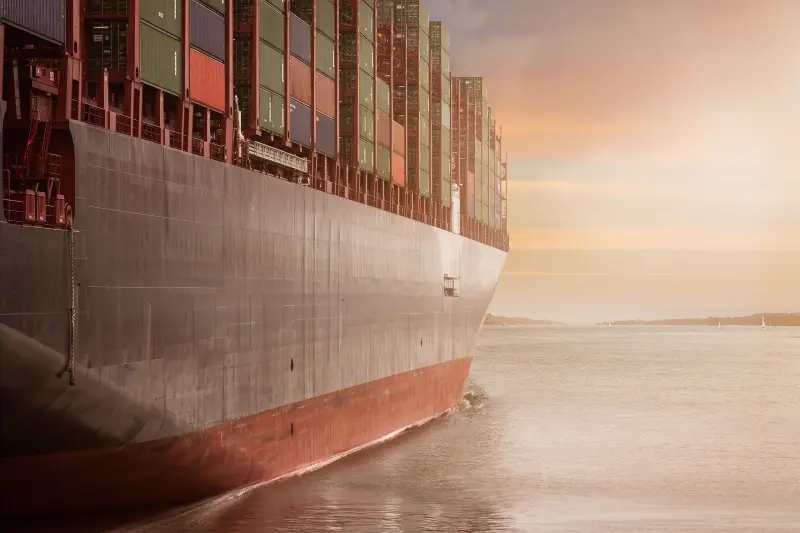
The standard steel container made moving goods faster, cheaper and easier to manage — and helped create the global supply chains businesses rely on today.
Walk through almost any supermarket, electronics shop or warehouse and there is a good chance that many of the products around you have travelled through the same basic piece of infrastructure: a steel shipping container.
The box itself is simple. Its impact on business and international trade has been anything but.
Containerisation changed the way cargo moves between ships, ports, trains and trucks. By putting goods into standard-sized units that could be transferred without unpacking the cargo, it cut handling costs, reduced loading times and made long-distance supply chains far easier to organise.
Almost 70 years after the first major container voyage, the system remains at the centre of world trade.
The idea began with a simple problem
Before containerisation became widespread, cargo was generally handled piece by piece.
Workers loaded barrels, sacks, crates and other individual items onto ships. The same goods then had to be unloaded at the destination and transferred to another form of transport.
That process was slow, expensive and vulnerable to damage and theft.
American trucking entrepreneur Malcolm McLean saw an opportunity to change the system. On 26 April 1956, his converted tanker Ideal-X left Newark, New Jersey, carrying 58 containers bound for Houston.
The voyage itself was not the revolutionary part. The important change was that cargo could be moved as a single unit rather than being repeatedly handled as individual pieces.
Historical research records the enormous difference in loading costs. Loading conventional break-bulk cargo was estimated at about $5.83 per ton, compared with roughly 15.8 cents per ton using McLean’s container system — a reduction of about 97%.
That saving gave shipping companies a powerful reason to adopt the new system.
Standardisation turned the idea into an industry
McLean’s original containers were not the same size as every container used today.
That mattered because containerisation only becomes truly efficient when the same equipment can be handled at different ports and transferred between different forms of transport.
International standardisation gradually solved that problem. ISO standards established common specifications for freight containers, allowing ports, railways, trucks and shipping companies to build equipment around compatible dimensions. ISO notes that standardisation was critical to creating an interoperable system rather than leaving different shipping companies with incompatible container designs.
That standardisation was arguably as important as the container itself.
A business could increasingly ship a container from one country knowing that cranes, trucks, trains and ports at the other end were designed to handle the same basic unit.
The result was a logistics network rather than a collection of separate transport systems.
Bigger ships followed
Once cargo could be stacked in uniform units, shipping companies could design vessels specifically around containers.
The modern container ship is therefore not simply a larger version of an old cargo ship. Its design, terminals and handling equipment are all part of the same system.
The scale has grown dramatically since the 1950s.
The first Ideal-X voyage carried just 58 containers. Modern container ships can carry more than 20,000 twenty-foot equivalent units (TEUs).
That scale allows shipping companies to spread many fixed costs across enormous volumes of cargo.
But the economics do not stop at the ship.
Ports have invested in specialised cranes and terminals. Railways and trucking companies have developed equipment for moving containers inland. Warehouses and distribution centres have been designed around the predictable flow of standardised cargo.
In other words, containerisation changed an entire industry rather than simply introducing a new type of box.
It helped make global supply chains practical
The biggest economic effect may have been the reduction in the cost and complexity of moving goods over long distances.
When transporting cargo becomes cheaper and more predictable, companies have more options about where they manufacture, source components and distribute finished products.
That does not mean the container alone created globalisation. Trade agreements, lower tariffs, improvements in telecommunications, cheaper air travel, industrial development and the growth of manufacturing centres all played major roles.
But containerisation provided an important piece of the physical infrastructure required to connect those markets.
Marc Levinson’s history of the industry, The Box, documents how the container helped transform transportation economics and contributed to the expansion of international trade.
The change is visible in today’s supply chains. A product can be designed in one country, assembled using components from several others and sold around the world — with containers providing the physical link between many of those stages.
The system also created new vulnerabilities
The same efficiency that made global supply chains attractive has created new risks.
Modern trade depends heavily on a relatively small number of major ports and maritime routes. When one of those routes is disrupted, the consequences can spread well beyond the shipping industry.
The Suez Canal is a good example.
UNCTAD estimates that the canal handled roughly 12% to 15% of global trade in 2023. During the Red Sea shipping crisis, many vessels were diverted around the Cape of Good Hope instead. UNCTAD reported that the longer route from Asia to Europe can add thousands of nautical miles and roughly ten days to a voyage.
That extra distance means higher fuel consumption, longer journeys and greater demand for ships.
It can also affect businesses that have nothing to do with shipping.
A retailer waiting for stock, a manufacturer waiting for components or an importer facing higher freight costs can all feel the effects.
COVID showed the downside of efficiency
The pandemic provided one of the clearest demonstrations of how dependent modern business has become on containerised logistics.
Factory closures, changes in consumer demand, port congestion and shortages of shipping equipment disrupted supply chains around the world.
Freight rates increased dramatically, while businesses struggled with delays and unreliable delivery schedules.
The experience challenged an assumption that had become common in global manufacturing: that companies could keep inventories relatively lean because supplies would arrive reliably when required.
That model can work extremely well when transport is predictable.
It becomes much more difficult when a major port closes, a canal is blocked or vessels have to take a much longer route.
Chokepoints have become a business issue
Recent disruptions have reinforced that lesson.
UNCTAD has warned that geopolitical tensions and climate-related problems are putting pressure on major maritime chokepoints, including the Suez and Panama canals. In 2024, disruptions forced ships onto longer routes, increasing vessel demand and putting additional pressure on freight capacity.
UNCTAD’s 2025 Review of Maritime Transport also reported that the Red Sea disruption pushed container freight rates sharply higher during 2024 as ships were diverted around Africa.
For businesses, this turns shipping from a background logistics issue into a strategic consideration.
Companies now have to think about alternative suppliers, inventory levels, shipping routes and the resilience of their supply chains.
The container is still evolving
The basic idea has remained remarkably consistent, but the industry around it continues to change.
Ports are becoming increasingly automated. Digital tracking is making it easier to monitor containers. Shipping companies are investing in larger and more efficient vessels, while governments and businesses are under increasing pressure to reduce emissions from maritime transport.
At the same time, the growth of global trade has created new questions about whether supply chains should be optimised purely for cost.
The disruptions of recent years have encouraged many companies to consider resilience alongside efficiency.
That can mean holding more inventory, using more than one supplier or sourcing some components closer to the final market.
A small invention with a very large economic impact
The shipping container did not create global trade by itself.
What it did was remove one of the major physical barriers to moving goods between countries.
By standardising the way cargo is packed, handled and transferred, containerisation allowed ships, ports, railways and trucks to operate as parts of a single logistics network.
That helped reduce costs, speed up cargo handling and make international supply chains practical on a scale that would have been difficult to achieve with traditional break-bulk shipping.
Today, maritime transport carries more than 80% of the world’s movement of goods.
The next time a product arrives from another continent, the most important part of its journey may not be the ship, the port or the truck.
It may simply be the standard steel box connecting all three.